Data Science for operational excellence of complex systems
1. Industrial Intelligence
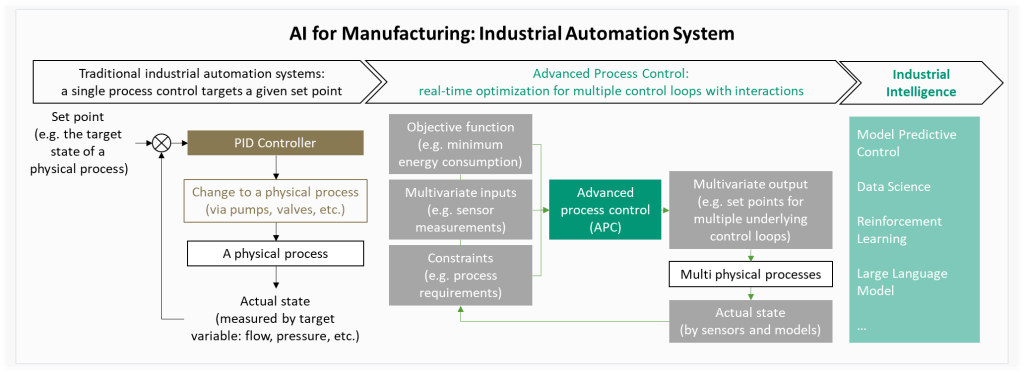
This research explores the integration of machine learning, Large Language Models (LLMs), and advanced control systems to revolutionize industrial process optimization and support new energy transformation. The project combines theoretical advances in AI with practical control engineering to:
- Create adaptive control strategies (PID, MPC) that optimize both business and environmental metrics
- Advance novel AI frameworks that bridge business intelligence and operational control
- Develop Industrial Intelligence in integrating complex industrial processes, experts experience, and real-time optimal control of the system.
Publication:
- An industrial process optimization framework: from data to deployment with case studies in food production processes.
Liu, L., He, X., Ye, Y., & Li, L.*
Journal of Intelligent Manufacturing (2025): 1-28.
https://doi.org/10.1007/s10845-025-02755-6
2. Low Altitude Economy: Traffic Management
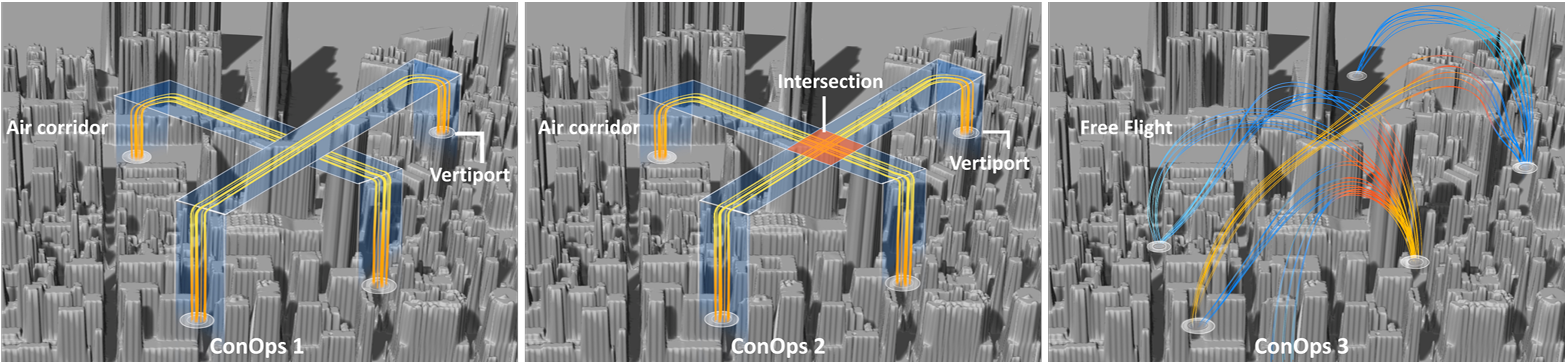
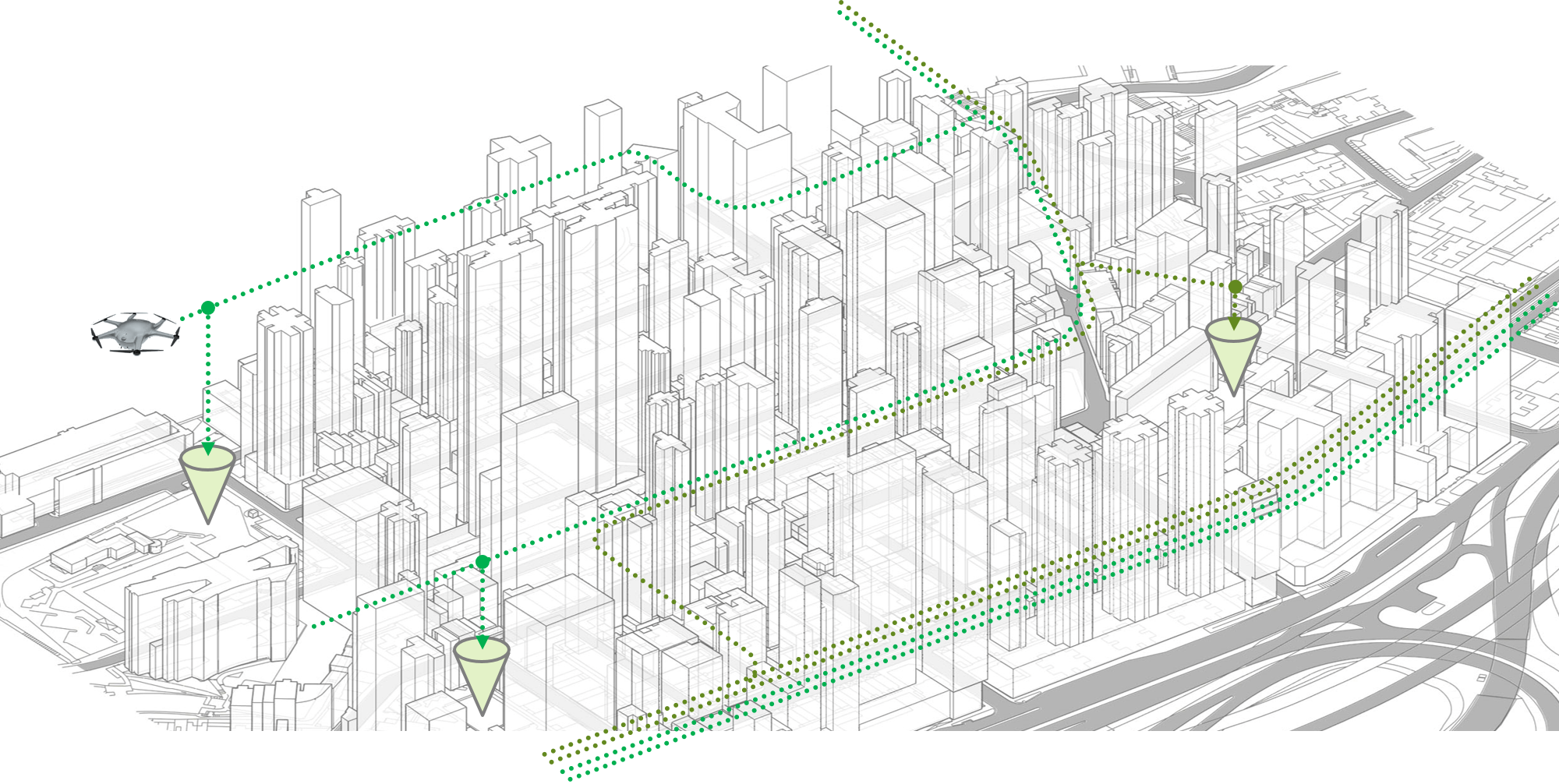
With advancements in drone technology, many companies worldwide are working on small package delivery using Unmanned Aerial Systems (UAS). A major challenge is scaling operations in crowded cities. This research focuses on the design and development of UTM systems, considering various stakeholders and the social and environmental effects.
Papers:
- Path Pool Based Transformer Model in Reinforcement Framework for Dynamic Urban Drone Delivery Problem.
Xiang, C., Mo, Y., Liu, W., Wu, Z., & Li, L.*
Transportation Research Part C: Emerging Technologies. 2025, 177, 105165.
https://doi.org/10.1016/j.trc.2025.105165 [PDF] - Air Corridor Network Planning for Urban Drone Delivery: Complexity Analysis and Comparison of Multi-Commodity Network Flow and Graph Search.
He, X., Li, L.*, Mo, Y., Sun, Z., & Qin, S. J.
Transportation Research Part E: Logistics and Transportation Review. 2025, 193, 103859. https://doi.org/10.1016/j.tre.2024.103859 [PDF] - A Distributed Route Network Planning Method with Congestion Pricing for Drone Delivery Services in Cities.
He, X., Mo, Y., Huang, J., Li, L.*, & Qin, S. J.
Transportation Research Part C: Emerging Technologies. 2024, 160, 104536. https://doi.org/10.1016/j.trc.2024.104536 [PDF] - Evaluation of urban wind effects on flight path planning of delivery drones using computational fluid dynamics simulations.
Wang, J., He, X., Jiang, S., Chan, P.W., Li, C., Ou, J., Duan, P.* and Li, L.
Physics of Fluids, 2025, 37(8). https://doi.org/10.1063/5.0281373 - Identification of No-Fly Zones for Delivery Drone Path Planning in Various Urban Wind Environments.
Jiang, S., Wang, J., Li, C., Ou, J., Duan, P.*, & Li, L.
Physics of Fluids, 2024, 36(8). https://doi.org/10.1063/5.0221281 [PDF] - A Route Network Planning Method for Urban Air Delivery.
He, X., He, F., Li, L.*, Zhang, L., & Xiao, G.
Transportation Research Part E: Logistics and Transportation Review, 2022, 166, 102872. https://doi.org/10.1016/j.tre.2022.102872 [PDF] - A Simulation Study of Risk-Aware Path Planning in Mitigating the Third-Party Risk of a Commercial UAS Operation in an Urban Area.
He, X.*, Jiang, C., Li, L., & Blom, H.
Aerospace, 2022, 9(11), 682. https://doi.org/10.3390/aerospace9110682 [PDF]
Pre-prints:
- Pre-Planned Air Corridors or Dynamic 4D Trajectories? A Comparative Study of UTM ConOps
He, X., Bai, S., Wang, Z., Zhang, B., Huang, G., Mao, Y., & Li, L.*,
(2024). Available at https://ssrn.com/abstract=5284875 - Constraint-Aware Deep Reinforcement Learning for Generalizable Drone Routing Solutions.
Xiang, C., Wu, Z., & Li, L.*
(2025). Available at https://ssrn.com/abstract=5127607 or http://dx.doi.org/10.2139/ssrn.5127607
Patents:
- Grid Based Path Search Method for UAV Delivery Operations in Urban Environment,
He, F., Li, L., & Zhang, L.
(2024) US Patent No. US11,915,599, Priority No. 17/468,615. - Route Network Planning for Drone Logistics in Urban Environment
He, F., Li, L., Zhang, L., & He, X. (filed with USPTO).
3 Air Transportation Systems
3.1 Aerospace Systems Prognostics and Health Management
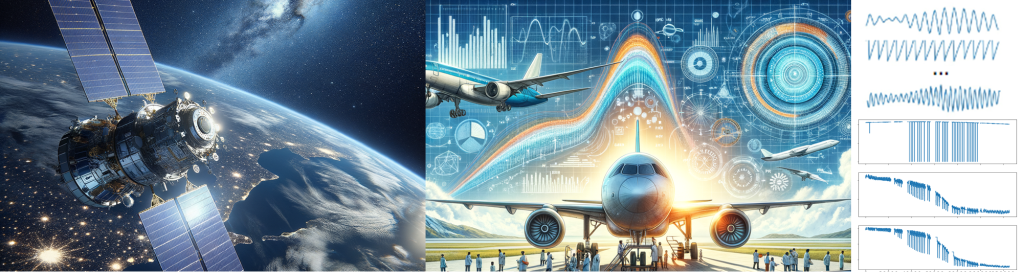
Maintenance of aerospace systems is expensive and requires a lot of work, making task planning for different satellite types difficult. However, aerospace telemetry data, which is wirelessly transmitted from spacecraft sensors to ground stations, provides important chances to monitor and predict system status. This project aims to create models for predicting satellite faults using multiple sensor data, which will lower maintenance costs and boost safety and reliability, and algorithms to improve the coordination between ground stations and various satellites, increasing efficiency and reducing costs.
Papers:
- Learning Satellite Pattern-of-Life Identification: A Diffusion-Based Approach.
Y. Ye, X. Zhu, X. Shen, X. Chen, S. J. Qin and L. Li*
in IEEE Transactions on Aerospace and Electronic Systems, doi: 10.1109/TAES.2025.3624708. [PDF] [Code] - Data-Driven Approaches for Satellite SADA System Health Monitoring with Limited Data.
Zhu, X., Li, L.*, Mo, Y., Dong, Y., Shen, X., Chen, X., & Qin, S. J.
in the Proceedings of 2024 IEEE 20th International Conference on Automation Science and Engineering (CASE), Bari, Italy, 2024, pp. 3225-3230, doi: 10.1109/CASE59546.2024.10711383. [PDF] - A Hierarchical Scheme for Dynamic Monitoring of Multi-Scale Multi-Mode Systems.
Wang, J., Li, L., & Qin, S. J.*
Computers & Chemical Engineering, 2025, 109107. https://doi.org/10.1016/j.compchemeng.2025.109107
Pre-prints:
- Multiscale Multimode Modeling for Satellite Health Monitoring: Case Study on Solar Array Drive Assembly.
Zhu, X., Li, L.*, Mo, Y., Dong, Y., Shen, X., Chen, X., & Qin, S. J.
(2024). Available at SSRN 5296499. https://ssrn.com/abstract=5296499
Awards:
- MIT ARCLab Prize for AI Innovation in Space, 2024, 6th Place.
Ye. Y., Zhu, X., Li. L.
Read more at Group News
3.2 Flight Operations Monitoring Using FDR Data
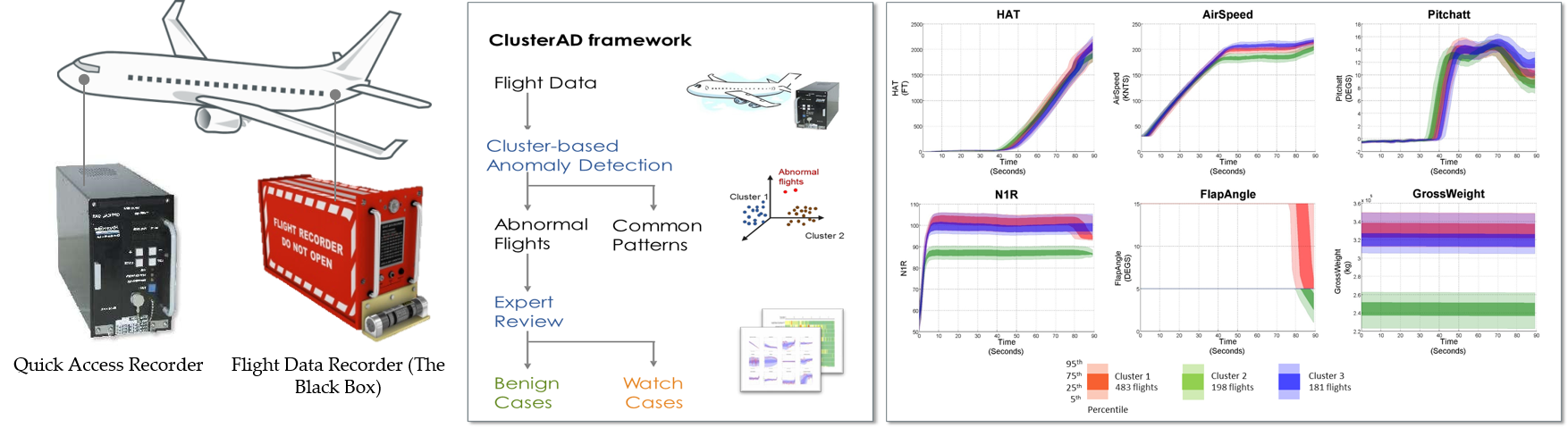
Despite ongoing safety improvements, accidents still happen, often due to human error or operational issues, even with hardware advancements. Airlines monitor flight operations using digital Flight Data Recorders (Black Boxes), but methods like Exceedance Detection are insufficient for proactive safety management. They only find known problems and usually provide updates after accidents, missing new threats. With plenty of data and better analytics available, there is a need for a new toolset that considers pilots, weather, and aircraft systems. This research proposes a systems-based approach to monitor flight operations proactively. By using big data and advanced technologies, we aim to create tools for identifying weaknesses in flight operations through new data-mining methods, validation processes, and case studies to improve safety management.
Papers:
- An Incremental Clustering Method for Anomaly Detection in Flight Data.
Zhao, W., Li, L.*, Alam, S., & Wang, Y.
Transportation Research Part C: Emerging Technologies, 2021, 132, 103406. https://doi.org/10.1016/j.trc.2021.103406. - Anomaly Detection via a Gaussian Mixture Model for Flight Operation and Safety Monitoring.
Li, L.*, Hansman, R. J., Palacios, R., & Welsch, R.
Transportation Research Part C: Emerging Technologies, 2016, 64, 45–57. https://doi.org/10.1016/j.trc.2016.01.007 [PDF] - Analysis of Flight Data Using Clustering Techniques for Detecting Abnormal Operations.
Li, L.*, Das, S., John Hansman, R., Palacios, R., & Srivastava, A. N.
Journal of Aerospace Information Systems, 2015, 12(9), 587–598. https://doi.org/10.2514/1.I010329 [PDF] - Flight Operations Monitoring through Cluster Analysis: A Case Study.
Charruaud, F., & Li, L.*
IEEE Intelligent Systems, 2015, 30(6), 24–29. https://doi.org/10.1109/MIS.2015.111 [PDF]
Patent:
- Method of Presenting Flight Data of An Aircraft
Li, L., Charruaud, F., Zhao W.
(2022) US Patent No. US11,299,288. View in CityU Patent Database
Press/Media:
- New tool analyzes black-box data for flight anomalies, MIT News, Sep 2011.
- Mining digital avionics data for future safety, Flight International by FlightGlobal, Nov 2011.
Video:
- Anomaly detection in flight data for airline safety,
Li,L.
AI & Aviation track, Applied Machine Learning Days at EPFL 2020, Lausanne, Switzerland. Jan 2020.
3.3 Flight Fuel Planning for Airlines
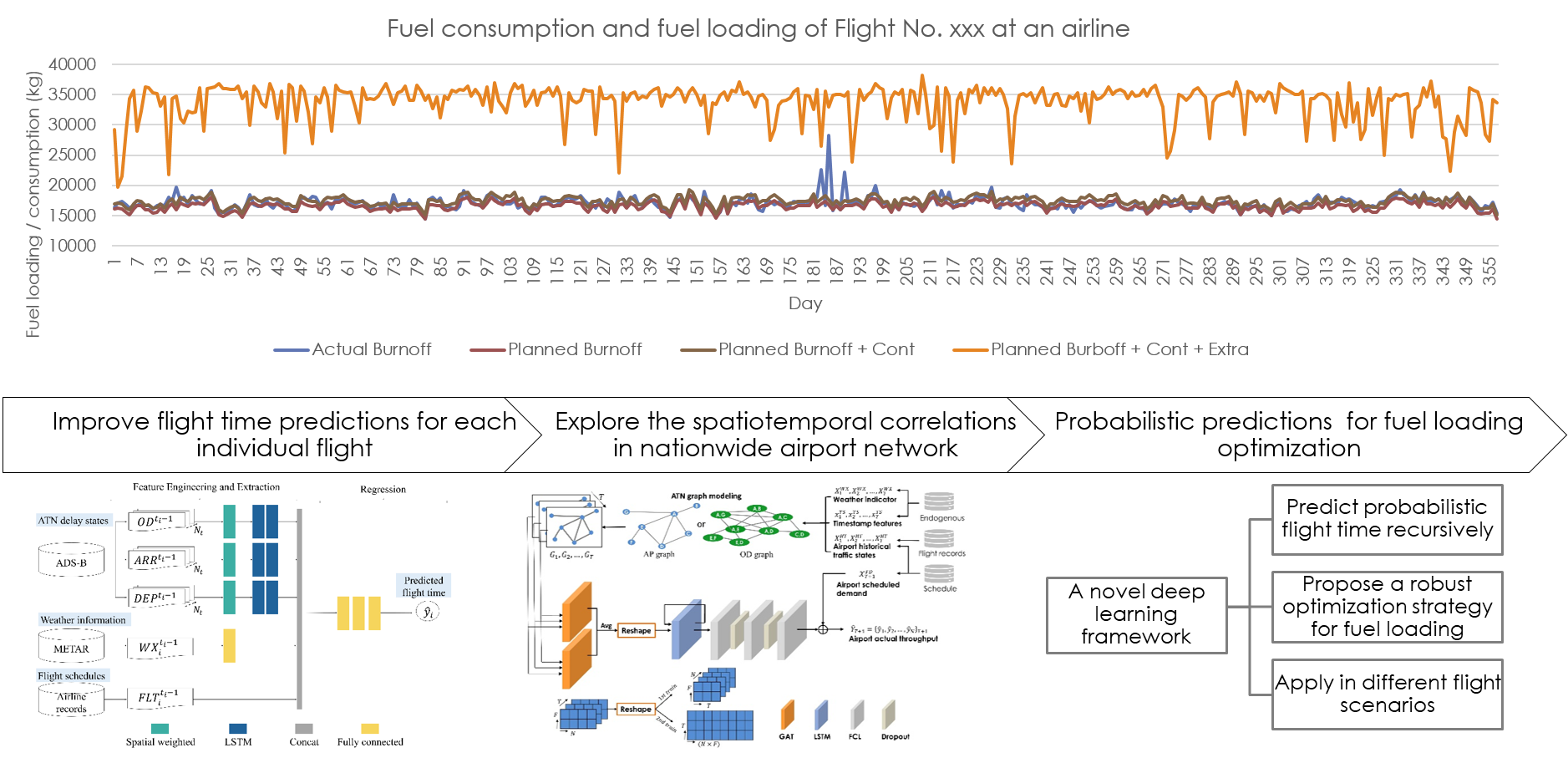
The airline industry is working to improve fuel efficiency due to high fuel costs and the need to reduce carbon emissions. Traditionally, focus has been on aircraft design, flight operations, and maintenance. Flight fuel planning is a new area for cost savings. Airlines often carry extra fuel based on past consumption, leading to unnecessary costs. By using data intelligence from operational data, we suggest a data-driven method to manage fuel consumption uncertainties. This research aims to create a model that accurately predicts each flight’s fuel needs by combining various data sources like traffic conditions and Flight Data Recorder data.
Papers:
- Short-Term Nationwide Airport Throughput Prediction With Graph Attention Recurrent Neural Network.
Zhu, X., Lin, Y., He, Y., Tsui, K. L., Chan, P. W., & Li, L.*
Frontiers in Artificial Intelligence, 2022, 5, [884485].
https://doi.org/10.3389/frai.2022.884485 - Multi-Graph Convolutional-Recurrent Neural Network (MGC-RNN) for Short-Term Forecasting of Transit Passenger Flow.
He, Y., Li, L.*, Zhu, X., & Tsui, K. L.
IEEE Transactions on Intelligent Transportation Systems, 2022, 23(10), 18155-18174. https://doi.org/10.1109/TITS.2022.3150600 - Flight Time Prediction for Fuel Loading Decisions with A Deep Learning Approach.
Zhu, X., & Li, L.*
Transportation Research Part C: Emerging Technologies, 2021,128, 103179. https://doi.org/10.1016/j.trc.2021.103179 [PDF]
3.4 Air Traffic Network and Delay Modeling Based on Trajectory Data

Air travel demand has increased worldwide over the past decade, especially in the Asia-Pacific region, causing crowded airspace and frequent delays that waste time, fuel, and negatively impact the economy and environment. One major issue is the lack of comprehensive operational data. However, the use of Automatic Dependent Surveillance–Broadcast (ADS-B), a satellite-based technology for tracking aircraft locations, presents new opportunities for analysis on a global scale. This research seeks to create new methods to analyze airspace congestion using real-time ADS-B data. The findings will assist air traffic service providers in identifying bottlenecks, setting benchmarks for monitoring, and allowing decision-makers to anticipate delay risks due to changes in network structure, infrastructure, or air traffic management.
Papers:
- Predicting Aircraft Trajectory Uncertainties for Terminal Airspace Design Evaluation.
Zhu, X., Hong, N., He, F., Lin, Y., Li, L.*, & Fu, X.
Journal of Air Transport Management, 2023, 113, 102473. https://doi.org/10.1016/j.jairtraman.2023.102473 - From Aircraft Tracking Data to Network Delay Model: A Data-Driven Approach Considering En-Route Congestion.
Lin, Y., Li, L.*, Ren, P., Wang, Y. & Szeto, W. Y.
Transportation Research Part C: Emerging Technologies. 2021, 131, 103329. https://doi.org/10.1016/j.trc.2021.103329 - Characterizing Air Traffic Networks via Large-Scale Aircraft Tracking Data: A Comparison between China and The US Networks.
Ren, P., & Li, L.*
Journal of Air Transport Management, 2018, 67, 181–196. https://doi.org/10.1016/j.jairtraman.2017.12.005 - Flight Trajectory Data Analytics for Characterization of Air Traffic Flows: A Comparative Analysis of Terminal Area Operations between New York, Hong Kong and Sao Paulo.
Murça, MCR.*, Hansman, R. J., Li, L. & Ren, P.,
Transportation Research Part C: Emerging Technologies, 2018, 97, 324-347. https://doi.org/10.1016/j.trc.2018.10.021
3.5 Health Monitoring of High-Speed Trains

Condition monitoring is essential for smart infrastructure, improving the reliability, safety, and efficiency of rail systems. It helps identify issues before they escalate, all while keeping operations running smoothly. This research aims to create easy-to-use analytical tools for condition monitoring that utilize sensor data. The objective is to develop simple, data-driven methods that are easy to implement and do not rely on complicated physics models, ensuring clarity in both the methods and results.
Papers:
- Physically Interpretable Wavelet-Guided Networks with Dynamic Frequency Decomposition for Machine Intelligence Fault Prediction.
Wang, H., Li, Y. F.*, Men, T., & Li, L.
IEEE Transactions on Systems, Man, and Cybernetics: Systems. 2024, 54, 8
https://doi.org/10.1109/TSMC.2024.3389068 - Knowledge-Informed Wheel Wear Prediction Method for High-Speed Train Using Multisource Signal Data.
Chen, C., Zhu, F., Xu, Z., Xie, Q., Lo, S. M., Tsui, K. L., & Li, L.*
IEEE Transactions on Instrumentation and Measurement, 2024, 73, 1-12. https://doi.org/10.1109/TIM.2024.3413151 - High-Speed Rail Suspension System Health Monitoring Using Multi-Location Vibration Data.
Hong, N., Li, L.*, Yao, W., Zhao, Y., Yi, C., Lin, J., & Tsui, K. L.
IEEE Transactions on Intelligent Transportation Systems, 2020, 21(7), 2943-2955. https://doi.org/10.1109/TITS.2019.2921785 [PDF]
Correction to “High-Speed Rail Suspension System Health Monitoring Using Multi-Location Vibration Data”.
Hong, N., Li, L.*, Yao, W., Zhao, Y., Yi, C., Lin, J., & Tsui, K. L.
IEEE Transactions on Intelligent Transportation Systems, 2021, 22(9), 6088-6088. https://doi.org/10.1109/TITS.2021.3092455 [PDF] - Condition Monitoring of Wheel Wear for High-Speed Trains: A Data-Driven Approach.
Xu, P., Yao, W., Zhao, Y., Yi, C., Li, L.*, Lin, J., & Tsui, K. L.
In 2018 IEEE International Conference on Prognostics and Health Management (ICPHM) (pp. 1–8). Seattle, WA. https://doi.org/10.1109/ICPHM.2018.8448864
Press/Media:
- Data-driven Management for Safe and Reliable Railway Systems, City University of Hong Kong – Research Stories, Mar 2021
 Lishuai Li